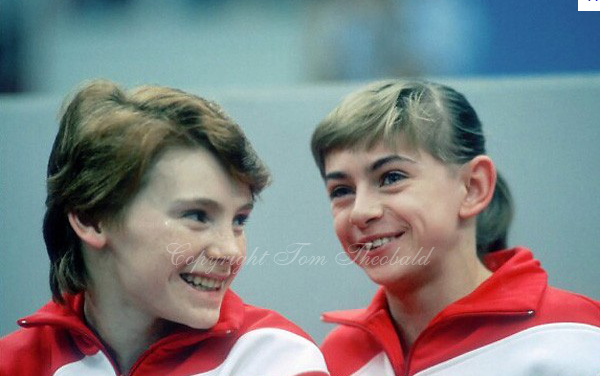
Elena Shevchenko and Viktor Razumovsky

Elena Shevchenko with 1985 World Champion all around, Oksana Omelianchik.  Picture courtesy Tom Theobald

I read somewhere recently that Moscow's Viktor Razumovsky is now coaching 2012 Olympian Anastasia Grishina ... interesting.  Razumovsky was a leading Soviet personal coach during the 1980s, bringing through such talent as 1988 Olympian Elena Shevchenko, 1987 World Championships team member Elena Gurova, and Soviet international Olga Chudina.  He also had a hand in coaching 1981 World Champion Olga Bicherova.  All renowned for the elegance and spontaneity of their floor work in particular.

It reminded me of the 1988 Olympics, when the Soviet team performed in red, won by a significant margin, and were led off by the placid yet dynamic Shevchenko. I like what Larissa Petrik has to say about her in this interview from GymnForum:

"Elena Shevchenko is my favorite gymnast ... We are similar in spirit, in style and ... in the colour of our hair.  When she goes out onto the floor, Elena very quickly gets the feel of the situation and in her performance she just slightly plays and flirts with the audience.  One senses a femininity in her that is as yet unaware of itself.
"My favorite elements of Shevchenko's program are the floor exercises and the vault.  As we say, Elena uses contrast.  She begins a combination softly, flexibly and then suddenly explodes, unexpectedly transforming the rhythmic pattern.  Elena's feel for rhythm, which very rarely lets her down, helps her achieve tremendous emotional expressiveness."
 Enjoy the video from Olegushko.


And I thought it would be worth linking to this video of Larissa Petrik, on beam at the 1968 Olympics - she is a wonderfully fluid gymnast. I so miss the rhythm and line of a truly balanced and harmonious beam routine.


Comments

Popular posts from this blog

Tatyana Nabiyeva on work and love in China

Some highlights from a long interview with 2010 World champion Tatyana Nabiyeva.  Source: Russian team page on VK.com.  Translation - Google translate A big interview with Tatyana Nabieva about the peculiarities of work and life in China, the bright years of her sports career, a little about modern gymnastics and about love. On the Nabiyeva flight — At the same championship, you presented a new element on the bars, which was later added to the rules with your last name (flying over the top bar with a straight body, difficulty group F. — Sport24). How did you come up with the idea to try something new? — Actually, it happened spontaneously, I think. We worked with Vera Iosifovna [Kiryashova] on the purity of the elements on the bars, sometimes I didn’t fly all the way to the Shaposhnikova element. Once I didn’t fly all the way to the bars either and stood on my feet between the bars, bending my legs in flight for safety. Then Vera Iosifovna said that this was a different eleme...

Men's team results : Russian national championships

Full results are available here . In summary, 1    Moscow    (Olennikov, Garibov, Gogotov, Bondar, Stolyarov, Ablyazin)    261.55 2    Siberia       (Devyatovski, Pakhomenko, Ignatiev, Cherkasov, Golutsotskov  259.85 3   Central       (Barkalov, Nyudakin, Markelov, Perevoznikov, Bondar, Ignatenkov   255.00 Interesting - Mikhail Bondar appears to have competed for two teams simultaneously here - Moscow and Central - not sure how this works but quite pleased with myself for noticing it ;-)  Only his high bar score counted for the Central team.  One of the wonderful mysteries of Russian gymnastics.  Hopefully we'll have the women's team results later.  And perhaps I'll discover something even more wondrously mysterious there.  Who knows. 

The State of Gymnastics - 'Soviet' or 'American' style?

Lioudmilla Tourischeva, 1972 Olympic All Around champion in artistic gymnastics, was held up as an example of the ideal Soviet citizen.  Here she coaches one of the Soviet Union's leading gymnasts from the 1980 Olympics, Natalia Shaposhnikova The Soviet Union had a genius for lifting sport beyond the textbook, injecting the aesthetic where previously only goals had been in plain view.   This was not only manifest in gymnastics.  Do you remember the ‘Russian Five’, the players who elevated ice hockey to a creative sporting display, mesmerising their opponents and spectators with intricate patterns of play, so rhythmic and entertaining that they could have been set to music?   In gymnastics, a sport where the aesthetic counted as much as the outcome, it was this ability to create spectacle out of competition that resulted in the most extraordinary athletic performances.  The ‘Golden Era’, most commonly understood to cover the years from 1952-1...

RRG Archive - scroll by date, from 2024 to 2010

Show more