
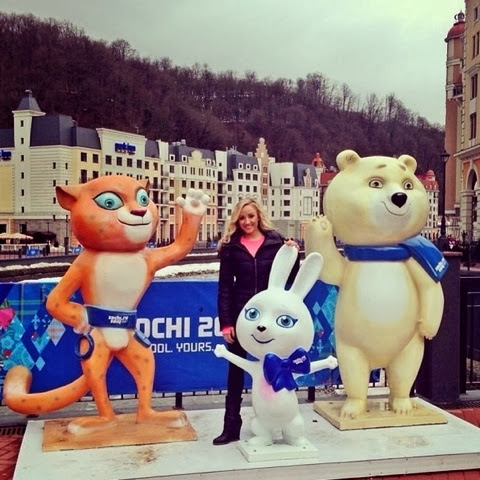
2008 Artistic Gymnastics Olympic Champion, Nastia Liukin, in Sochi this week. The Sochi Winter Olympic Games begin in seven days' time. Picture : Sportivnaya Gymnastika on VK.com
The headline costs are being paid by VTB, a bank still in the majority ownership (70% or thereabouts) of the Russian government. VTB's interests rest not only in gymnastics, but in wider sport. For example, the new VTB Arena, built on the site of the former Dynamo sports centre, is rumoured to be costing around US $1.5 billion, and will be a main venue for the FIFA 2018 World Cup. (There was initially some doubt as to whether gymnastics facilities would be delivered here, but this doubt seems to have been allayed and the Club is expected to re-open in its old home some time around 2015 or 2016).
Regional and national government is also making investments, although it is very difficult to find the facts and figures; most of the information drips through in dribs and drabs. Press coverage of facility openings is one channel of information, but more frequently social media sites release details. It is generally very difficult, though, to see a complete picture.
Russia's interpretation of sports investment largely rests in big-time sport; President Putin's interest in his country's heroic exploits at Olympics and World Championships seems to be a driving force, and there is an expectation of gold medals in return for all the money. Putin also seems to want to leave his mark on the landscape. He isn't a Communist, but he shares his fascination for grandiose construction projects with former Communist dictators, Stalin and Ceausescu. His passion for the mega event has completely transformed the landscape of Sochi, the home of the upcoming Winter Olympic Games, and similar transformations were made in Kazan, in readiness for last year's Universiade. Much of the building is beautiful, and some of it seems to have a great social purpose, for example the new urban rail system in Kazan. Perhaps the economic legacy will be worth it for Russia, but the interests of many have been sidelined along the way, according to emerging reports and documentaries. I will link to some of them below.
If mega events are important to Russia's image and Putin's ego, they will not by themselves improve Russia's chances of success in a sport like artistic gymnastics. Here, the investment in large scale training facilities is important, but might not be worth much if Russia isn't successful in its efforts to retain and develop a new generation of well trained and ambitious young coaches. This is dependent on ample reward, high quality degree programmes, and appropriate national training structures at both development and elite levels. Reward and coach education seem to be in sparse supply today in the Russian Federation, and the issue of how training can be structured is contested and uncertain. These activities are not high profile or glamourous, but in many ways they are vital to the progress of artistic gymnastics in the Russian Federation as a sport. Russian gymnastics is lucky to have such loyal sponsors as VTB, but need to get their basic priorities sorted out if they are to produce champions beyond the Rio Olympics.
Elsewhere, question marks are being raised as regards the cost of the Winter Olympics - social, community, environmental and financial - and question marks are being written above the names of the oligarchs who are providing much of the investment, and many of whom seem likely to profit significantly from the Games. As ever in Russia, the word corruption is being spoken. I haven't enough knowledge to comment, but the links I provide below seemed important enough for me to bend the focus of my blog a little. I am also looking forward to these Games immensely, and to seeing a little more of the country that so interests me, so I am providing a link to the BBC's daily guide to the Games. I hope that some of you will find this interesting.
BBC Guide to the Winter Olympics : http://www.bbc.co.uk/sport/0/winter-olympics/25763228
The National Post : Sochi Olympics Cost and Construction http://news.nationalpost.com/2014/01/31/sochi-olympics-costs-and-corruption-a-look-at-the-massive-venues-and-the-tycoons-behind-their-construction/
Sochi 2014 : Encyclopaedia of Spending : http://sochi.fbk.info/en/award/
BBC Iplayer - Panorama - Putin's Games (30 minute TV documentary - available until 3 February 2014) : http://www.bbc.co.uk/iplayer/bigscreen/tv/episode/b03t8dm9/Panorama_Putins_Games
HAHAHAH.Corruption, social and environmental costs. You are very knowledgeable when they appear in the eyes of the reader, about the social and financial conditions in Russia. And I almost went linxada this blog when he said that the FIFA World Cup and the Olympics in Brazil are impractical, that corruption and overpricing of Stadiums, and the abandonment of schools, and public safety hopitais?? Now put Liukin happily as propaganda. Fifa forced Brazil to exchange the black presenter by another blonde, blue-eyed model .... But I'll be lynched for saying this here too. Absurd FIFA, the Olympic Committee, and politicians who allow to make our Country a bed of white elephants.
ReplyDeleteThank Putin and VTB to be also investing in athletes and sport in general. Therefore, neither the gifted is the President of Brazil.
ReplyDeleteI understand tickets are still available for the opening ceremony and several of the big events, including gold medal finals and the Russia v USA hockey match, so if anyone is out there ...
ReplyDelete